
You can learn to play the saxophone
You can learn to play the saxophone, but where do you do that? How long does it take before you notice real progress? Here you will find tips on starting with a saxophone.
Check out our range of saxophones for children
The basics
There are apps, YouTube videos, and other online solutions, which are often very suitable for a somewhat advanced student. A beginner student benefits most from a professional saxophone teacher. This is because a teacher ensures that the basics are correct. This way, you don't develop bad habits that you will have to unlearn later.
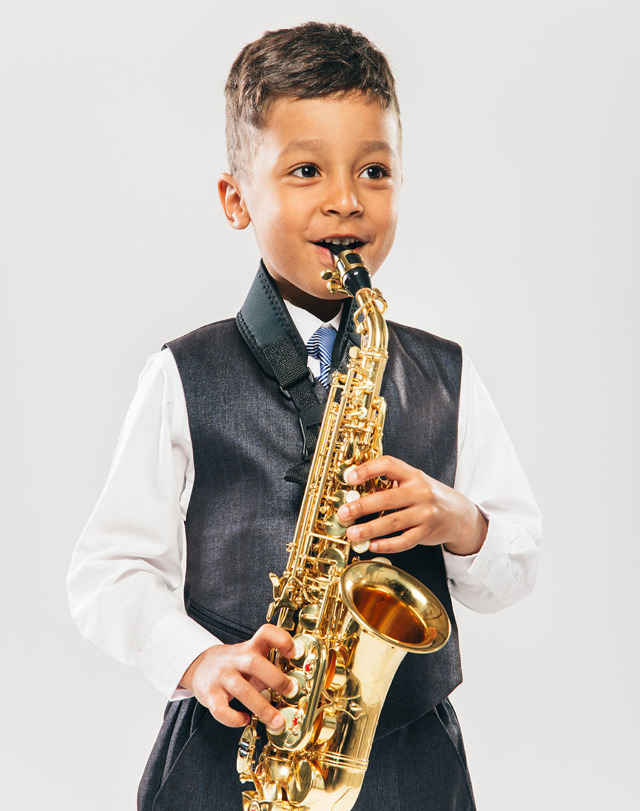
There is no age limit for learning the saxophone; even if you are 75, learning the saxophone is still a fun challenge. For children, it is important that their fingers can reach the keys, and for this, a number of special children's saxophones have been designed. Most people start on an alto or tenor saxophone, as these are the easiest saxophones to play and the most well-known.
On a saxophone, you can play a song fairly quickly. There might still be an occasional wrong note or squeak. With about six months to a year of lessons and practice, those squeaks will disappear. To achieve a truly beautiful sound, it will take a few years of practice, and you need to play a lot, preferably every day. But you will definitely notice your improvement over the course of the year.
Do I need a teacher?
For beginners, a teacher is the most valuable asset. A good saxophone teacher ensures that you learn the right basics: breathing, embouchure, finger placement, and posture. Bad habits acquired at the beginning are difficult to unlearn later on.
Apps and YouTube tutorials are useful, but they do not correct you. They are better suited as a supplement for someone who has been playing for a while than as a starting point for a complete beginner.
Have you been playing for a while and do you want to improve on a specific aspect? Then you can effectively combine targeted online instruction with occasional lessons with a teacher.
General tips
Practice briefly but daily.
Twenty minutes a day is better than one and a half hours once a week. Your embouchure and finger memory develop through repetition, not through long sessions.
Is an exercise not working?
Put it aside for a few days and work on something else. When you return to it later, it often goes surprisingly much better. Your brain processes motor skills outside of practice time as well.
Find a good practice space.
A place where you don't have to worry about neighbors or other listeners makes it easier to dare to make mistakes. And making mistakes is part of learning.
Can't play for a day?
Breathing exercises keep your embouchure in shape. Ask your teacher which ones are most useful for your level.
Record yourself.
Your own playing sounds different when you listen back than when you are playing yourself. Recordings help you hear what is really going well, and what isn't yet.
Frequently Asked Questions
How do I tune my saxophone correctly using the mouthpiece?+
Slide the mouthpiece further onto the cork for a higher tuning, and pull it off slightly for a lower tuning. Warm up the saxophone before tuning; a cold instrument sounds lower than a warm one. Tune your saxophone to an F#. Always make minor corrections with the mouthpiece, never by blowing differently or adjusting your embouchure.
How often should I lubricate the cork with cork grease?+
Lubricate the neck cork as soon as the mouthpiece no longer slides smoothly onto the cork. Do not use too much cork grease — a thin layer is sufficient. With normal use, this is necessary every few weeks, depending on how often you play and how dry the cork is. A cork that is too dry can be damaged if you try to place the mouthpiece with force.
Which saxophone should you choose to start with?
Most beginners start on an alto saxophone. It is smaller and lighter than the tenor, requires less finger stretching, and is generally cheaper as a beginner instrument. For children under twelve, the alto is almost always the best choice.
Do you specifically want to learn the tenor? That is also possible. But if you are still unsure, start on the alto.
Read more about which saxophone suits you best.
Aziëstraat 17-19
6014 DA Ittervoort
The Netherlands
+31(0)475 560 700
[email protected]
Bosstraat 73
3560 Lummen
Belgium
+32(0)13 35 20 20
[email protected]