Which saxophone is right for me?
Most beginners choose an alto saxophone: it is smaller, lighter and more affordable than a tenor. Whether a saxophone suits you also depends on your level, your musical style and your budget. If in doubt, try a few instruments before you decide.
Buying the right saxophone starts with two questions: which type suits you, and what level of instrument do you need? Adams helps you make that choice, with personal advice, a wide range in stock and a repair department that technically checks every instrument before it leaves the shop.
Alto or tenor. Which should I choose as a beginner?
This is the question most beginners ask, and for most people the answer is the same: start on the alto saxophone.
The alto saxophone is smaller and lighter and requires less finger stretch than the tenor. This makes it easier to hold and play, especially at the start. A beginner alto saxophone is also usually more affordable than a comparable tenor.
The tenor saxophone is larger and sounds lower. It is not necessarily harder to play than the alto, but it requires more lung capacity and a different embouchure. For children under twelve, the alto is almost always the better choice because of its more compact size.
If you have been playing for a while and specifically want to learn tenor, you can certainly start on tenor straight away. If you are still unsure, choose the alto. Read more about all types on our page about types of saxophone.
Which saxophone should I choose?
The overview below helps you choose the right type.
| Type of saxophone | Who is it for? | Sound and character | Musical styles | Advantages |
|---|---|---|---|---|
| Alto saxophone | Beginners, advanced players, all-round players | Warm and versatile | Pop, jazz, classical, concert band and fanfare |
|
| Tenor saxophone | Advanced players, adult beginners, jazz lovers | Deep, full and warm | Jazz, pop, rock, blues |
|
| Soprano saxophone | Advanced players | Direct and expressive | Jazz, classical, solo playing |
|
| Baritone saxophone | Advanced players, ensemble players | Very deep, powerful and round | Jazz, big band, orchestra, funk |
|
Still unsure? Visit us and try different saxophones in our test rooms. You will immediately feel which instrument best suits your playing style.
New or second-hand?
A new saxophone gives you certainty. The pads are new and the lacquer or silver plating is flawless. You know the instrument has the latest mechanism and has been made using modern production techniques. You get a warranty from both the manufacturer and the shop. For beginners, there is also a psychological advantage: you start with an instrument that has no history.
The disadvantage of a new saxophone is the price. A new instrument sometimes costs several times as much as a comparable second-hand model. Mass production also often loses some of the craftsmanship. At Adams, we check every instrument before sale and fix any problems, often free of charge.
A second-hand saxophone often gives you more instrument for the same money. Many players also feel that vintage saxophones have a richer sound. At Adams, second-hand instruments are always checked and overhauled where necessary, and they come with a 12-month warranty. Read more about buying a second-hand saxophone.
What is your playing level?
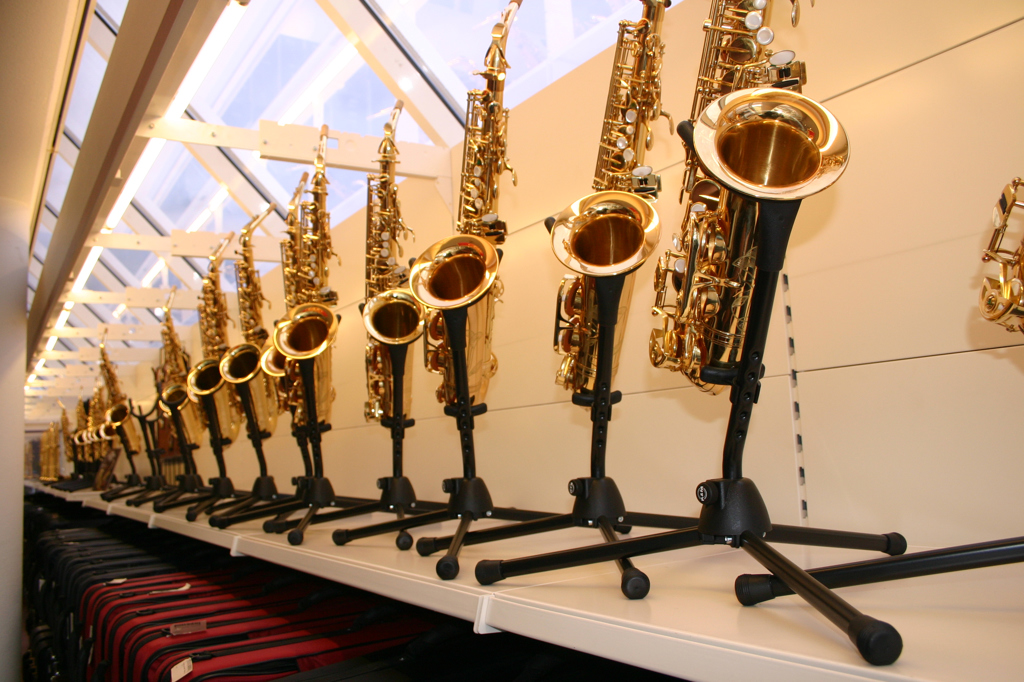
Whether you are a beginner or a professional, Adams offers a wide choice of brands and types of saxophone.
Children's saxophones
Children aged nine or younger have smaller hands and are still growing. A standard alto saxophone can then be difficult to hold. That is what special plastic saxophones are for. They suit small hands, need little maintenance and can take a knock. They are also handy if your child is not yet sure whether they want to keep playing. View all children's saxophones.
Saxophones for Beginners
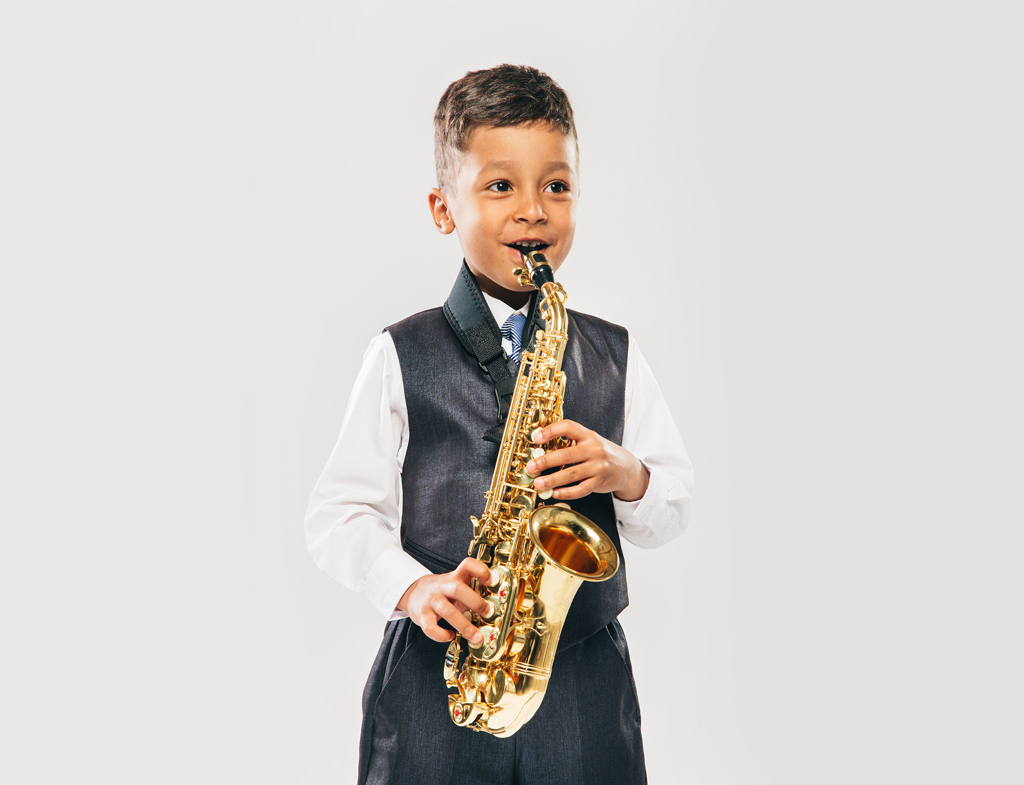
As a beginner, you want an instrument that gives you a good start without costing a fortune if the hobby does not stick. We recommend mid-range alto and tenor saxophones for beginners. They are versatile, easy to play and good enough to grow with during your first years. Also take a look at our second-hand range: for the price of a new beginner instrument, you can sometimes buy a better second-hand saxophone. Maintenance costs are roughly the same for every saxophone, whether it is a beginner or a professional model.
Beginner instruments are usually built in China, Indonesia or Taiwan and are made of brass or a combination with gold brass. Also read our tips for beginners.
Saxophones for advanced players
Have you been playing for a few years and perhaps passed your first music exams? Then it is probably time to trade in your beginner instrument for a better one, or to replace your band's instrument with a saxophone of your own. Most major brands have an advanced model alongside their professional flagship that is ideal for this step. Also take a look at professional second-hand saxophones.
Advanced instruments are generally built in Europe, the US or Japan and are made of brass or gold brass.
Saxophones for professionals
As a professional saxophonist, you probably already know which direction you want to go. Even so, we recommend talking to our specialists first. Discuss maintenance costs and which genre the instrument suits, and ask about alternatives to the model you have in mind. View all our saxophones.
How do you test a saxophone?
No two saxophones are the same. Every type, every brand and even every individual instrument has its own intonation and tone colour. If possible, bring someone who plays the saxophone and can try the instrument for you. If you play yourself, it is easy to get caught up in the moment and be less critical.
As a saxophonist, always bring the following when you go to test a saxophone:
- Your own mouthpiece, or that of the person testing the instrument
- Cork grease
- A tuner
- Reeds in different strengths
If you are a beginner, examine the saxophone as carefully as you can. If it is a used instrument, check the body for damage and find out in advance which problems are common with that model. Ask a saxophonist you know to play every note, both loud and soft. Also play a slow chromatic scale from the lowest to the highest note. This lets you hear whether any pads are leaking or keys are not closing properly.
A test for advanced players: play the overtones of B-flat, B, C and D and compare them with the same notes using their normal fingering. The sound will differ slightly, but on a good saxophone the pitch stays the same.
Frequently asked questions
At what age can a child start playing the saxophone?+
Most children start between the ages of eight and ten. What matters is not so much age, but whether their fingers can comfortably reach the keys. For children who are still too small for a standard alto saxophone, there are children's saxophones.
Isn't a saxophone too heavy for a child?+
An alto saxophone weighs about 2 to 2.5 kilos. That is manageable, but young players can find it tiring after a while. A standard neck strap puts all the pressure on the neck. A harness spreads the weight across the shoulders and back and is highly recommended for children. View our range of saxophone straps and harnesses.
Why is the alto saxophone the most popular choice for beginners?+
The alto saxophone is smaller and lighter than the tenor, requires less finger stretching, and is generally cheaper as a beginner instrument. Furthermore, the range of beginner instruments and teaching materials for the alto is the largest. For children under twelve, the alto is almost always the best choice.
Can I still start playing the saxophone as an adult?+
Yes. There is no age limit for learning the saxophone. Adults often have the advantage of practicing more disciplinedly and understanding what a teacher explains more quickly. All you need is an instrument, a teacher, and consistency.
Is a plastic saxophone a good alternative to a metal instrument?+
For young children or as a first introduction, a plastic saxophone can be useful. They are lightweight, virtually maintenance-free, and resistant to impact. However, the sound and playing response are completely different from those of a metal instrument. A plastic saxophone is for experimenting and perhaps learning the first steps. Adams offers plastic saxophones as children's saxophones, but for serious learning, we recommend a metal instrument.
Why buy from Adams?
Adams checks every instrument, new and second-hand, before it leaves our shop. Where necessary, we readjust it or replace parts, often free of charge. With a new saxophone, you receive a free service check within the first year: we readjust your instrument and let you know whether any maintenance is needed. Second-hand saxophones come with a 12-month warranty.
Visit us in Ittervoort or Lummen to try saxophones. If you want to be sure a particular model is ready for you, book an appointment in advance.
Customer experiences with Adams
Customers from across Europe rate our service
4.6 out of 5 stars on Google Reviews and 4.8 out of 5 stars on Trustpilot.
Customers particularly mention the knowledgeable and friendly staff, honest advice, clear communication, fast and carefully packed deliveries and the easy online ordering process.