
What should I look for when buying a second-hand saxophone?
A used saxophone often offers great value for money. At Adams, all second-hand instruments are fully inspected and maintained by our repair department before being offered for sale. Therefore, you are buying an instrument that is in good technical condition.
We always recommend coming to test the instrument in one of our stores in Ittervoort or Lummen before purchasing. You can read more about testing a saxophone on our page about buying a saxophone.
Why a second-hand saxophone?
Used saxophones offer a number of advantages that a new instrument does not have.
The materials and craftsmanship of older saxophones are often excellent, provided they have been well maintained. Moreover, vintage saxophones more often feature engravings and a richer finish than modern models. They are more likely to be silver-plated, gold-plated, or nickel-plated than lacquered, and the brass is slightly older, making it harder. As a result, it sounds different, fuller.
Furthermore, for the same price as a beginner's instrument, you can sometimes purchase a professional model. That is an advantage that rarely applies to new instruments.

Assessing Condition
How do I assess the condition of a saxophone?
You've found a second-hand saxophone you're interested in. Hopefully, you recognize the basic parts and common issues that saxophones face, such as the pads. But this is just the beginning. Just like with a car, it’s wise to “look under the hood” to find out what repairs, maintenance, and care the instrument has received or may still need. These factors can be subtle but have a significant impact on both the price and the quality.
Selling your saxophone?
We also trade in saxophones. Let us know which saxophone you want to trade in.
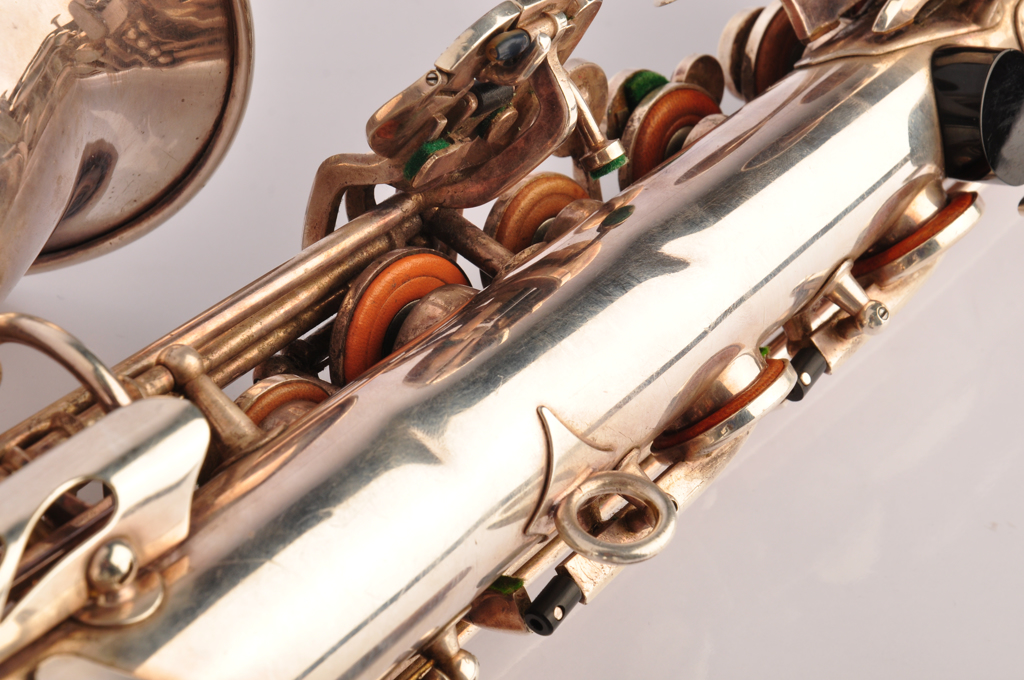
How do I determine the general condition?
As soon as you open the case, you get a first impression. Does the instrument shine? Then it has either hardly been played or has been very well cared for. Does the musical instrument have green stains or an unpleasant odor? Then caution is advised.
Of course, there are exceptions to every rule; do not let an unpleasant smell deter you from asking further questions. Later, you will read which questions you can ask an owner.
A word of warning: if the owner says "this instrument belonged to...", be critical unless he has proof. Instruments from famous players usually stay within the family or go to a good musical partner. They rarely remain in the open for sale.
There are questions that a private seller must be able to answer. If the owner does not know this information, chances are high that he is a sales specialist or has not owned the saxophone for long. If someone cannot answer any of these questions and is nervous, the saxophone may be stolen. In that case, ask for the serial number and check this via the MusicalChairs database. If the instrument has been reported stolen, call the police.
What questions should I ask the seller?
Is the instrument in good technical condition?+
The most important thing is that you can play your saxophone. Unfortunately, a beautiful-looking example with keys that do not close properly is only suitable as a decorative object.
What is the exact serial number?+
With the serial number and the brand, you can look up the instrument in our serial number database to see how old it is. You can also check on other websites if it has been stolen, and find out exactly which type it is via the manufacturer.
What is the model name or model number?+
Some models are known as almost legendary: the Selmer Mark VI, for example. The model matters, but the most important thing is that you enjoy playing on it.
When was the last full maintenance service?+
This shows how well the instrument has been cared for. A saxophone should have been taken to a repairer at least every 3 to 5 years. Also ask who performed the maintenance and look up that workshop.
How long have you had the saxophone?+
Someone who has owned the instrument for years knows much more about its history than a middleman who only wants to sell it.
Who owned the instrument before you?+
Just like with a second-hand car, a previous owner tells you a lot about a saxophone. Some players treat their instrument with the utmost care, others play it hard until it shows.
Does the instrument still have its original lacquer or silver plating?+
The original finish says a lot about how the instrument has been treated. A new layer of lacquer may also indicate damage that has been repaired.
Do you play this instrument regularly, or has it been sitting idle for a while?+
An instrument that has been sitting idle may need maintenance. Take this into account when negotiating the price.
Buying a second-hand saxophone at Adams
At Adams, second-hand saxophones are always fully technically inspected by our repair department before being offered for sale. If necessary, the instrument is overhauled first. This ensures that your instrument is ready to play.
Trading in your current saxophone? That is possible. We appraise the instrument and offer a fair price in return. More information about trade-ins.
View our current selection of second-hand saxophones or visit us in Ittervoort or Lummen to try out an instrument.
Aziëstraat 17-19
6014 DA Ittervoort
The Netherlands
+31(0)475 560 700
[email protected]
Bosstraat 73
3560 Lummen
Belgium
+32(0)13 35 20 20
[email protected]