
Buying a second-hand trumpet: what should you look out for?
Buying a second-hand trumpet is often a smart choice. As an advancing player, you can get a professional model for the same money you would spend on a new intermediate instrument. Or find a solid starter model at a keen price.
Our repair technicians in Ittervoort and Lummen assess second-hand trumpets every day. Because we manufacture our own trumpets, we know exactly where the weak points are. That knowledge is on this page.
Buy a trumpet from a well-known brand. Such as Bach, Adams, or Yamaha. Brand-name trumpets are often more expensive than unbranded trumpets, but parts for brand-name trumpets are usually available if needed.
Valve Compression
Through the back-and-forth movement of the piston, the valve casings and pistons gradually wear out. This can cause a "leak." A leak means that the air does not flow through the valve tubes but escapes along the valve. A trumpet with poor compression can be repaired.
An easy way to test this is to slide the valve slide out as far as possible without removing it from the instrument, and then press the valve. If you hear a 'pop,' the compression is good.
Red Rot
Are there red spots on the trumpet, especially on the leadpipe, valve tubes, or water key? Then it’s likely that this is not just damage to the finish but red rot. Basically, red rot means that the instrument has started to rust. This happens more often when saliva stays in the instrument for a long time. A small spot of red rot is not too serious. You just shouldn’t feel the metal give when you press on it.
To repair red rot, it is often necessary to replace that section of the tubing entirely.
Preventing red rot is mainly done by not eating or drinking just before playing. Blow all the saliva out of the instrument when you are done playing and oil the instrument regularly. Clean the instrument regularly or have it cleaned by a repair technician.
Silver Tarnish
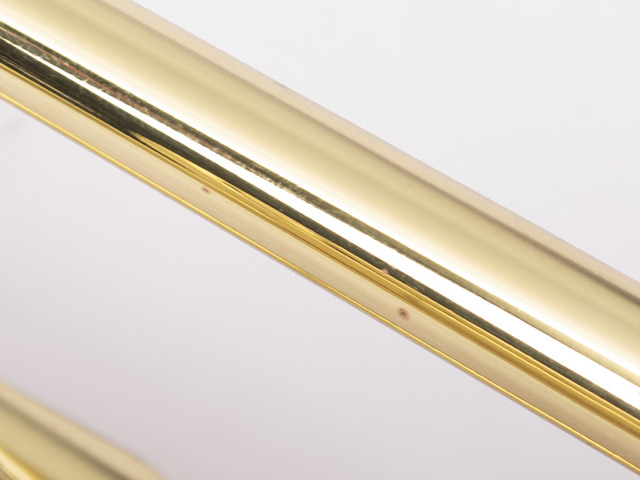
Silver tarnishes over time due to contact with air and sweat. This can often be easily polished away with a silver polish such as UniPol. So don't let a tarnished instrument discourage you.
Dents
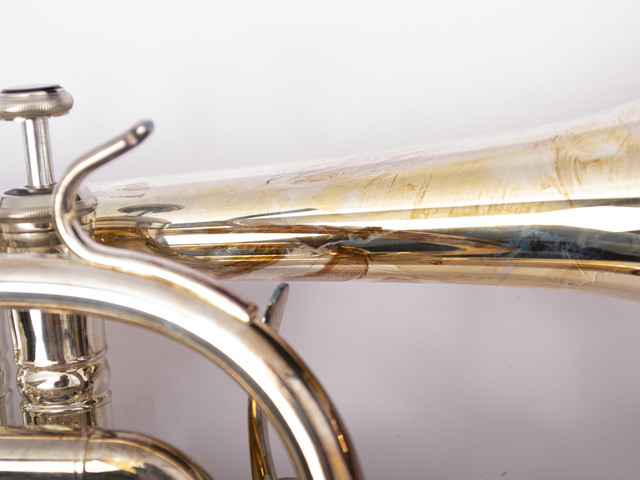
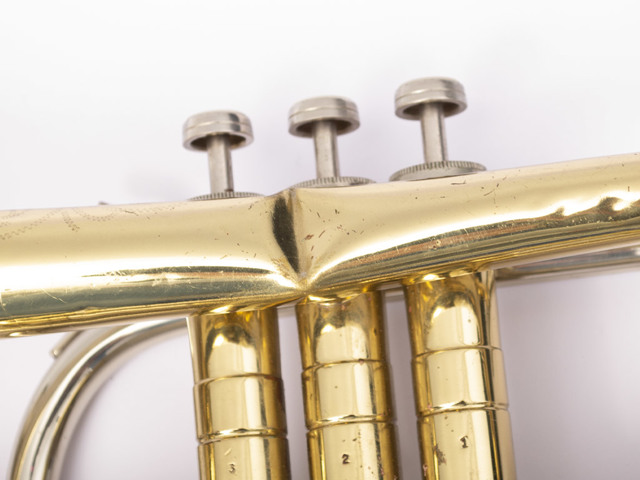
A used trumpet often has a few dents or scratches. The location of the dent is important to determine if it can be repaired affordably. Therefore, ask the seller if you can take the instrument to a professional repair technician; they can often tell you how much it will cost to repair.
For a scratch, it is important to know how deep it is. A scratch that goes down to the metal can later become a spot where red rot develops.
Serial Number
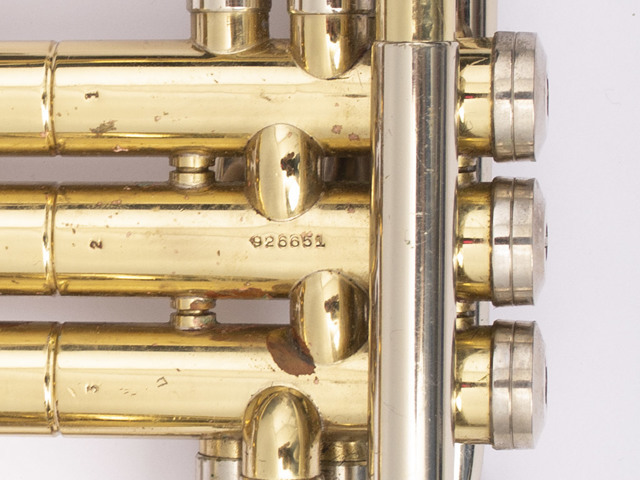
When you know the serial number and the brand of a trumpet, you can look up the instrument in our serial number database to see how old it is. You can also check on other websites to see if the instrument has been stolen. Often, you can also find out from the manufacturer which model trumpet you have.
Questions to ask the seller of a second-hand trumpet
Is the instrument in good technical condition?+
This is the most important question. A beautiful-looking instrument with poor valve compression is not playable. Ask the seller this directly and test the valves yourself before negotiating further.
What is the exact serial number?+
With the serial number and brand you can look up the instrument in our serial number database to find out how old it is. You can also check whether the instrument has been reported stolen. The manufacturer can often tell you which exact model you are looking at.
What is the model name or model number?+
The model says something about the quality and history of the instrument. Some models are known as exceptionally good, such as the Martin Committee. But the most important thing remains that it plays well for you: buy an instrument that you enjoy playing.
When was the last full service?+
A trumpet should be checked by a repair technician at least every 3 to 5 years. Ask who carried out the service and look up that workshop. What do other customers say about their work?
How long have you owned it, and who owned it before you?+
A seller who has owned the instrument for years knows far more about its history than someone who is simply reselling it. Just like with a second-hand car, the previous owner tells you a lot: some players treat their instrument with great care, others push it to its limits.
Has the instrument been sitting unused for a while?+
A trumpet that has not been played for a long time sometimes needs a minor service. Bear this in mind when negotiating the price.
Why are you selling the trumpet, and how did you determine the price?+
These two questions give you insight into the seller's motivation. Someone who can clearly justify the price knows their instrument well. Someone who cannot may also not know what is wrong with it.