
How do I maintain my saxophone?
How do you keep your saxophone in the best condition? What can you do yourself and what should you leave to a saxophone specialist? Here you can find everything about maintaining your saxophone. We discuss assembling your saxophone, cleaning your saxophone after playing, and what you can do weekly, monthly, and yearly to maintain your saxophone.
BEFORE PLAYING
Make sure your hands and mouth are clean before playing, especially your mouth. Food residues can cause the pads to stick sooner and make the instrument smell. Furthermore, food residues can also get stuck between the mouthpiece and reed, damaging the reed.

Placing the mouthpiece
First, put the mouthpiece on the neck and then place the neck on the saxophone to prevent damage to the neck. When tuning, make sure to hold the saxophone neck firmly so that it does not bend due to the pressure applied when you want to adjust the mouthpiece.
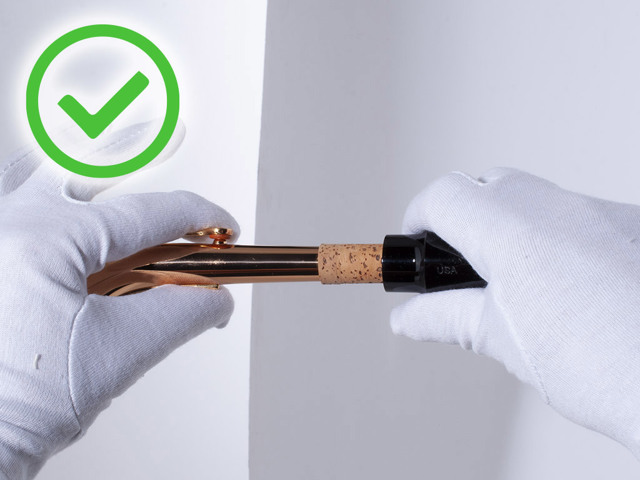
Use the right technique
Place the mouthpiece on the neck by setting it straight against the neck and then twisting it on. Do not slide it on. Screw the mouthpiece about two-thirds onto the cork. Is it not going smoothly? Then use some cork grease on the neck's cork.
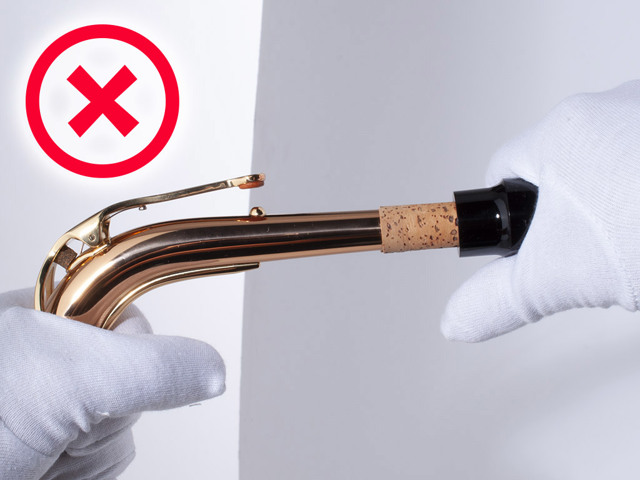
Placing the neck
After putting the mouthpiece on the neck, place the reed and ligature on the mouthpiece. The line on the mouthpiece should align with the top of the ligature. The top of the reed should align with the tip of the mouthpiece. Then, place the neck on the saxophone body.
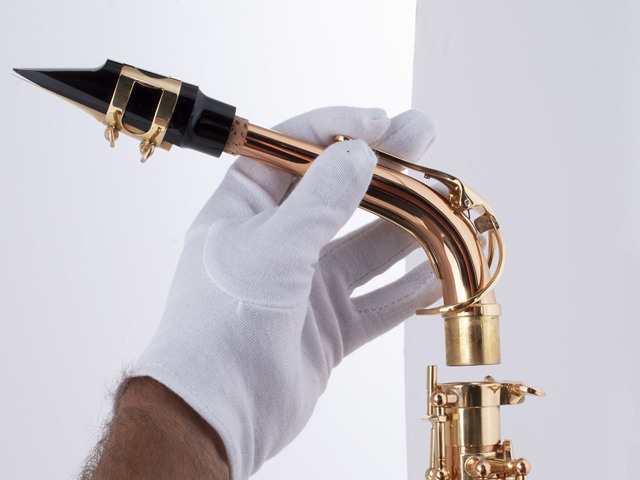
Putting on the saxophone strap
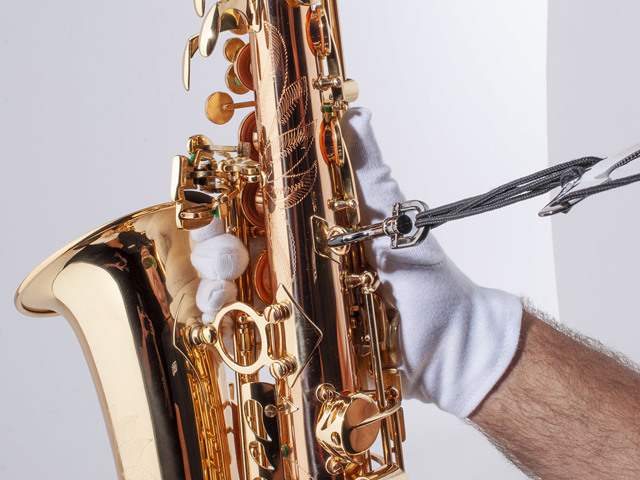
The next thing you do is take your saxophone strap and put it on, so you can immediately attach your saxophone to the strap to prevent it from falling. Never leave your saxophone hanging on the strap alone; the strap is only meant for support.
Contents of the case
Store only your instrument in the case. For your music stand and sheet music, it is best to use a separate compartment or even a separate bag. Only the instrument, a few reeds, your saxophone strap, and your mouthpiece should be in the case.

After playing
First, remove the neck from the body and place it on a flat and stable surface. Do the same with the body. Then remove the reed and the ligature from the mouthpiece. Store the saxophone strap, the ligature, and the reed, and get your swabs. Usually, you have a swab for the body and a swab for the neck and mouthpiece. We recommend the BG A31 for this. For the body, you need to look for a suitable swab for the type of saxophone you play. We recommend the HW swabs for the body; you can find the U-Ten for tenor and the U-Alt for alto.
Prevention is better than cure
You have everything ready now. When you look inside the instrument, you will probably see some drops of moisture. This moisture contains acids and sugars that promote the growth of bacteria. These bacteria can cause the pads to rot and thus need to be replaced. The sugars also make the pads stick sooner. Pull the swabs through the neck, mouthpiece, and body. It is easiest to start at the largest opening and work towards the smallest. Pull the swab through the part you are cleaning 2 or 3 times. Finally, wipe the outside of the instrument with a clean lint-free cloth. Then store everything properly.
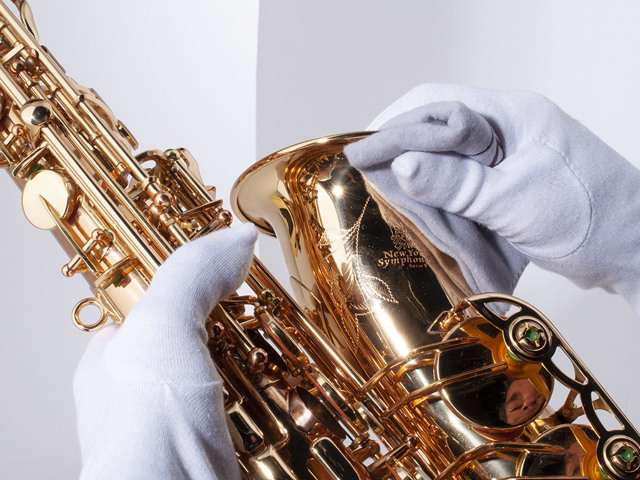
Weekly maintenance
Leave the case open at home for half an hour once a week to allow any remaining moisture to evaporate.
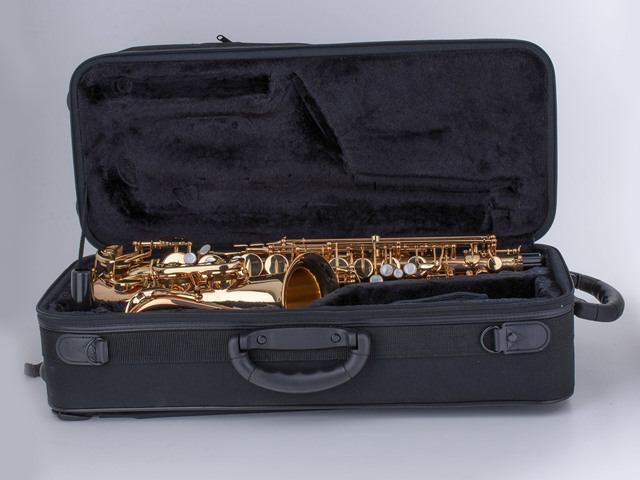
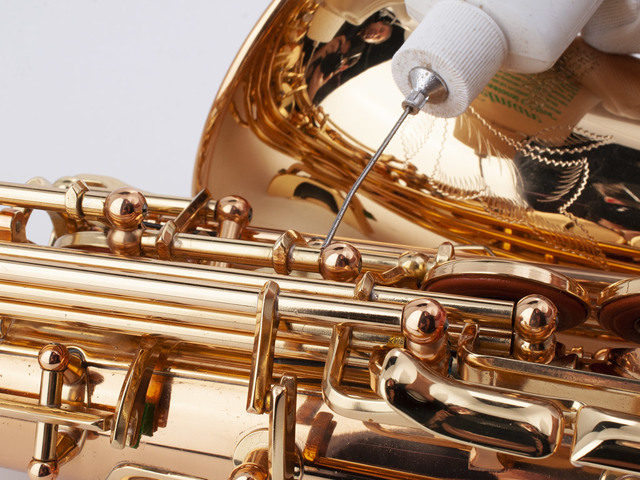
Annual maintenance
The keys, screws, and springs need to be lightly lubricated from time to time. We recommend having this done by a professional repair technician. You can also choose to do it yourself, and for this, it is best to use Key Oil. Be careful not to get grease, water, or oil on the pads, as this can cause the pads to harden and not seal properly.
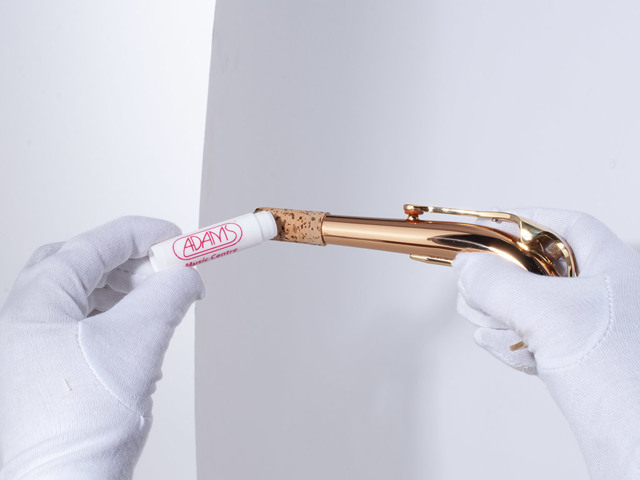
Tenon cork
The tenon cork should be greased with cork grease as soon as the cork is dry or the mouthpiece does not slide smoothly over the cork. This ensures that the various parts can be easily separated and do not get stuck.
Sticky pads
If you have trouble with sticky pads, usually the G# or the low C# on a saxophone, you can use powder paper preventively. Take a sheet of powder paper and place it between the pad and the tone hole, with the powder side facing the pad. Then close the key with a light finger pressure and carefully pull the sheet out of the closed key. The G# and low C# keys are closed at rest. Therefore, these keys tend to stick more often. For this, you can use Key Leaves. These keep the keys open and allow moisture to evaporate better.

Repair or maintenance
Take your instrument to a specialized repair shop once a year. Also visit a repair technician if you think your instrument is not playing well anymore. They will check your instrument to see if maintenance is needed. During such a visit, you will also be informed about what maintenance will be needed in the future. This way, you are always well informed and aware of the condition of your instrument.

Discover our range of saxophones
The saxophone is a versatile wind instrument with a powerful, expressive sound and is used in various genres such as jazz, pop, classical and wind orchestra. Within the assortment you will find different types, such as the alto saxophone (ideal for beginners), the tenor saxophone with its warm, full sound and the soprano saxophone with a bright, direct tone. When choosing the right saxophone, factors such as intonation, ergonomics, response and finish play an important role.
Accessories for saxophones
A good saxophone deserves the right accessories. Whether you are just starting out or have been playing for years, with the right saxophone accessories you get more out of your instrument and yourself. At Adams you will find a carefully selected range of accessories for alto, tenor, soprano and baritone saxophone. From mouthpieces and reeds to cases, stands and maintenance products, everything you need to play comfortably and with confidence.
Frequently Asked Questions
Can I safely clean my saxophone myself?+
Yes. Use a pull-through swab for the body and a separate swab for the neck and mouthpiece. Always pull the swab from the largest to the smallest opening. Do this after every playing session to remove moisture and saliva. Never use water or cleaning agents: these can damage the pads. Wipe the exterior with a soft, lint-free cloth.
Can I leave my saxophone on a stand, or must it always go back in the case?+
Always store your saxophone in the case after playing. On a stand, the instrument can tip over, resulting in dents in the body or damaged keys. Furthermore, the case protects the instrument from dust, temperature fluctuations, and moisture. A stand is handy during a rehearsal or when you take a break, but not as a storage solution.
How do I best store my saxophone to prevent oxidation and damage?+
Store your saxophone in its case in a dry place at room temperature. Avoid extreme heat, cold, or direct sunlight. Dry the inside of the instrument after every playing session before storing it. Regularly polish the exterior with a soft cloth to remove fingerprints and sweat. Sweat is slightly acidic and will eventually damage the finish.
My pads are sticky and making noise. What can I do about this myself?+
Sticky pads are most common on the G# and low C# keys, because those keys are closed at rest and moisture accumulates. Use powder paper: place a sheet between the pad and the tone hole with the powder facing the pad, close the key with light finger pressure, and carefully pull the sheet away. Repeat this if necessary. If the problem keeps recurring, have the instrument checked. Sticky pads that are not treated deteriorate more quickly.
How do I recognize an air leak in my saxophone?+
The clearest sign is that the low notes are difficult or impossible to produce, even though you are providing sufficient air. Another test: close all keys with light finger pressure and blow gently. On a well-sealed instrument, the low notes will just barely come out. If this does not happen, there is likely a leaking key. Take the instrument to a repairer for a thorough inspection.
How often does a saxophone neck cork need to be replaced?+
The neck cork wears down as you regularly slide the mouthpiece on and off. Replacement is necessary when the mouthpiece is too loose, or if the cork is visibly damaged or dented. With normal use and proper maintenance, a neck cork lasts for several years. Replacement is a minor procedure that a repairer can perform quickly.