Thijs van Leer
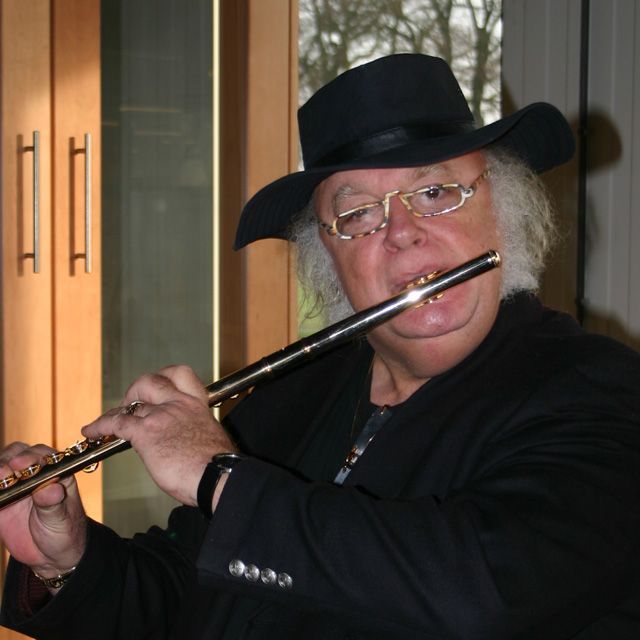
Thijs van Leer is perhaps the best-known flautist in the Netherlands. Together with guitarist Jan Akkerman, he was one of the best-known members of the band Focus. He also released several highly successful solo albums as a flautist. Through his performances with Focus and these solo albums, the transverse flute became one of the most popular musical instruments in the Netherlands from the 1970s onwards.
Thijs van Leer received piano lessons from his mother at the age of three, and later from Maria Stroo and Gerard Hengeveld. When he was eight, he wrote his first composition, which would later be recorded by Focus as Moving Waves. In his teenage years, in addition to classical music, he became interested in jazz. At the age of twelve, his father, who wanted to keep him on the classical path, gave him a transverse flute. His father, himself a famous flautist, also taught him. He completed grammar school and then briefly studied art history in Amsterdam and at the conservatory.
In 1966, Thijs van Leer won an interschool cultural competition and, as a prize, was allowed to record a single with arranger Rogier van Otterloo. Willem Duys was the driving force. The single went unnoticed. He then made his debut as a professional musician from February 1968 in the cabaret group of Ramses Shaffy, as a pianist and backing vocalist. In 1969, he founded the Thijs van Leer Trio. This trio accompanied the Dutch performances of the American musical Hair. During a recording session as backing band for the Christmas single "Vier ballen en een piek" by Neerlands Hoop (Freek de Jonge and Bram Vermeulen), he met the Amsterdam guitarist Jan Akkerman. He joined the trio, and under the name Focus, an album was recorded in that line-up in 1970, In and out of Focus.
Until 1976, several more albums would follow, all with Jan Akkerman as guitarist and with various bassists and drummers. In addition, Van Leer released solo albums as a flautist, on which he performed not only arrangements of classical pieces but also his own compositions, with backing vocals by Letty de Jong and arrangements by Rogier van Otterloo. These albums were released under the titles Introspection, Introspection 2 and Introspection 3. After Akkerman's departure in 1975, Van Leer continued with Focus, engaging two other guitarists. In 1978, Focus was disbanded, the year he had released Introspection 3. In the summer of 1979, Introspection IV followed. Van Leer continued his solo career, for a short time as Tys van Leer, but subsequently again under his own name. Van Leer released various albums of widely varying quality, including with the Van Leer Band, and Focus reunions followed in 1985, 1993 and 1998. A much-praised composition by Van Leer from that time is the rock oratorio Dona Nobis Pacem from 1985, later released on CD under the title Pedal Point.
In 2002, Thijs van Leer was invited to play in Hocus Pocus, a band founded as a tribute to Focus by his stepson Bobby Jacobs, the son of the producer of most of his solo albums, Ruud Jacobs. The collaboration went so well that he joined as a band member. Since then, the band has regularly performed under the name Focus and has also released new work. Thijs van Leer claims that at the time he, or actually his mother, came up with the name Focus. In February 2003, there were plans to record a Christmas album together with keyboardist Rick van der Linden (Ekseption), but this never materialised. The Introspection albums have been reissued on CD.
Thijs van Leer was appointed Knight in the Order of Orange-Nassau on 13 September 2008 in the church in Lathum.