The wonderful world of the saxophone by RUDY HAEMERS!
21 July 2008
On Saturday September 6, Rudy Haemers, renowned saxophone teacher and much sought-after soloist, was a guest at Adams for a very interesting lecture about the saxophone. The various saxophone models, mouthpieces, reeds, and so on were some of the components that make up this beautiful instrument and were discussed. In addition, prices, rental options and related matters were also addressed.
Rudy Haemers
Rudy Haemers was born in Kortrijk on April 1, 1959. After winning first prizes in music theory, saxophone and chamber music at the Royal Conservatory in Ghent, he continued his studies at the Lemmens Institute in Leuven, where he obtained the higher diploma in saxophone and chamber music in the class of Norbert Nozy. He also obtained diplomas from the conservatories of Maastricht and Amsterdam. Rudy Haemers is an internationally renowned soloist who regularly performs with other orchestras and in saxophone ensembles. He is a teacher at the Municipal Conservatory of Mechelen and conducts various wind bands. Rudy Haemers is considered one of the top saxophonists our country has and specializes in soprano and alto sax.
The saxophone
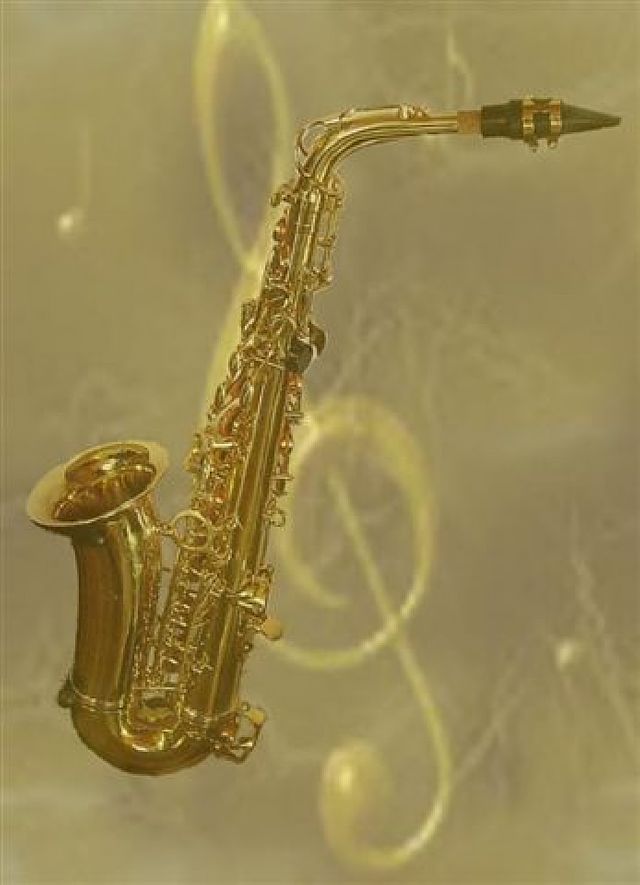
In the 1840s, the Belgian musical instrument maker Adolf Sax invented an instrument that soon gained great fame and has since borne the name of its inventor: the saxophone or abbreviated the "sax". He came up with the idea while experimenting with the mouthpiece of the bass clarinet, which he placed on various brass instruments.
The instrument is always made of metal but, like the clarinet, it is a single-reed instrument. As with the clarinet, the single reed is attached to the underside of the mouthpiece by means of a metal band. The bore is very wide.
Although the saxophone is made of brass, it is nevertheless often classified as a woodwind instrument because of the reed and because the playing technique closely resembles that of the clarinet. The fingering is like that of an oboe, the mouthpiece like that of the clarinet. A good clarinetist can often also play the saxophone.
To produce sound from the saxophone, you must force air between the reed and the mouthpiece. This sets the reed vibrating and produces a tone.
Keys ensure that the holes drilled in the body of the instrument can be closed. By pressing or releasing these keys you can produce different tones.
The ingenious mechanism requires proper functioning and therefore precise adjustment. The adjustment directly affects tone and playing qualities and a skilled craftsman is necessary for this. Depending on quality and use, maintenance is sometimes necessary.
Different materials of the mouthpiece can produce different tone colors. The strength and quality of the reed can also lead to different timbres.
Single "REED": for clarification, the tip is the front part on which you blow.
Not so much the thickness, but rather the stiffness of the reed is indicated by numbers (1 to 5) or by terms (soft, medium or hard).
Heavy
A heavy (stiff) reed produces a darker and fuller sound and gives more volume.
Pitch is more difficult to control and playing softly is also more difficult.
Light
A light reed responds more easily and produces a light and bright sound. Playing softly is also easier. However, pitch is more difficult to control.
Originally the saxophone family consisted of 14 members. Today only 9 types are still made. Four types, including the soprano sax, alto sax, tenor sax and baritone sax are usually used in a wind band and are still widely produced. All members of the saxophone family are:
- Soprillo in B-flat, straight.
- Sopranino saxophone in E-flat, usually straight.
- Soprano saxophone in B-flat, usually straight, also curved S-shape.
- Alto saxophone in E-flat and C ("C-melody"), S-shape.
- Tenor saxophone in B-flat, S-shape.
- Baritone saxophone in E-flat, S-shape, with extra curves.
- Bass saxophone in B-flat, S-shape, with extra curves.
- Contrabass saxophone in E-flat, S-shape, with extra curves.
- Subcontrabass saxophone in B-flat, S-shape, with extra curves.
The types indicated in red have somewhat fallen into disuse.
Like the clarinets, they are transposing instruments.
To obtain correct tuning it is necessary that the saxophone is first warmed up. By sliding the mouthpiece further or less far onto the neck, the saxophone can be tuned.